Most founders are still drawing the org chart from the last decade, a pyramid that scales headcount with ambition. The company worth building now has two roles, not ten layers: orchestrators and agents. The difference should shape the company from its first hire.
Ask a founder to draw their org chart, and you will almost always get a pyramid. A founder at the top. A row of leads. A row of managers. A wide base of people who do the work. It is the chart every operator has worked inside, so it is the chart they reproduce. It is also the wrong chart for the company they are now able to build. The pyramid encodes one assumption: capacity comes from headcount. To do more, you hire more, and you add managers to keep the larger group aligned. That assumption held for thirty years. It does not hold now.
The old org chart scaled headcount with ambition
In the old model, the size of the company tracked the size of the ambition. A bigger product meant a bigger team, and a bigger team meant more management. Much of the org chart was coordination overhead: people whose main job was to keep others pointed in the same direction.
Revenue per employee measured how efficient you were inside that model, and it had a ceiling. A strong software company might reach $300K to $500K in revenue per employee and consider that excellent. The number was bounded because the unit of capacity was a person, and a person has a fixed daily output.
The new org chart has two roles
The company an operator can build today does not have ten layers. It has two roles.
The first is the orchestrator. Orchestrators are people. Their work is judgment: deciding what should be done, directing how it gets done, and judging whether the result is good enough to ship. They own the outcome. They do not personally produce most of the work.
The second is the agent. Agents are AI systems doing scoped execution: research, drafting, code, analysis, outreach, reconciliation, support. An agent is not a tool the team picks up on the side of its real job. An agent is execution capacity that belongs to the company. The number of agents you run scales with ambition, the way headcount used to, without the salary cost or the coordination tax that headcount carried.
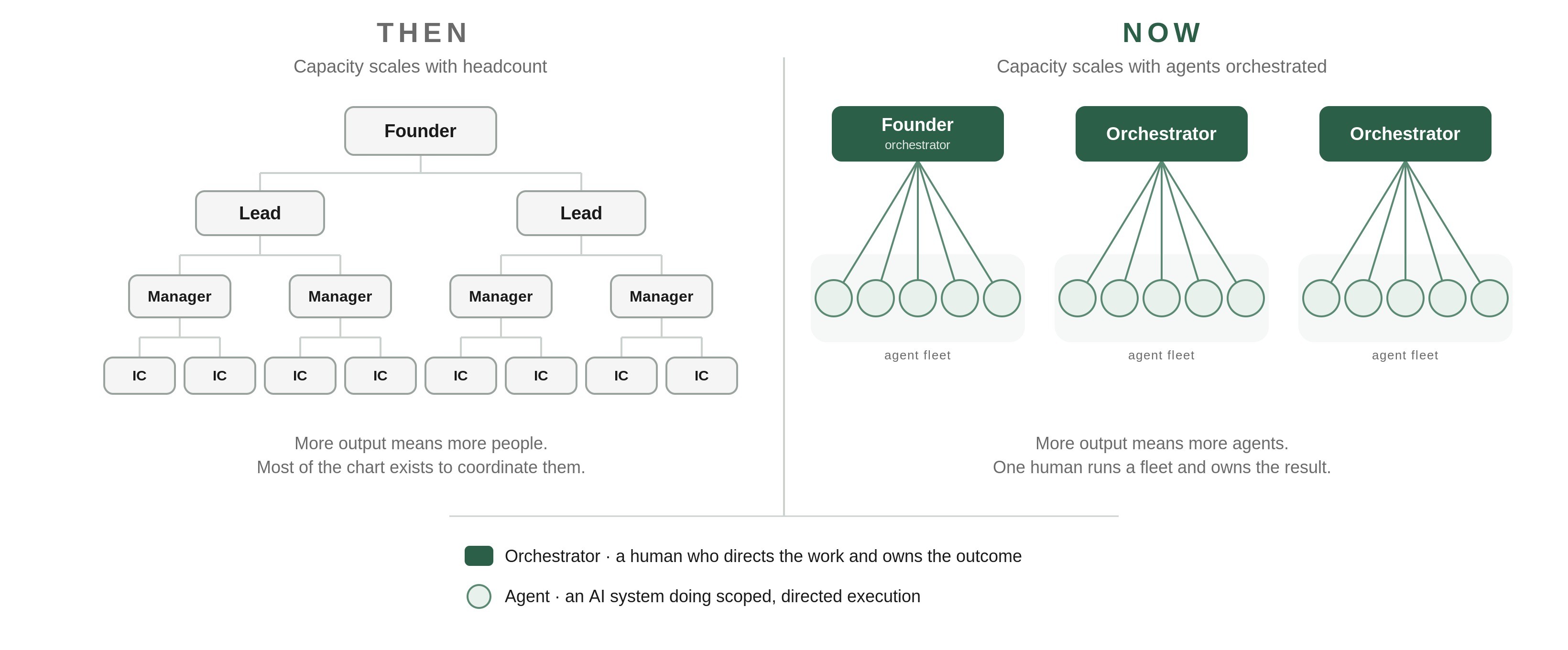
Two charts for the same ambition: headcount stacked in layers, or a small human layer running agent fleets.
The unit of capacity is no longer the person. It is the orchestration ratio: how many agents one capable human can direct before quality slips. That ratio, function by function, is the real org chart. Reporting lines barely matter.
Orchestrators own judgment and accountability
An orchestrator’s value is not throughput. It is taste and ownership. The orchestrator decides what good looks like, catches the agent output that is confidently wrong, and carries the result when it ships. Agents execute. They do not own anything. Every agent’s work has to roll up to a named human who is accountable for it. If a piece of work has no human owner, the org chart has a gap in it.
This changes who you hire first. The instinct is to hire people who can do the work. The better instinct now is to hire people who can direct the work and judge it. A junior who can only produce the unit of output an agent already produces is a weaker hire than someone who can run five agents producing it and tell which of the five results is right.
Agents are execution capacity, not tools
Treating agents as tools quietly keeps the old chart alive. A tool is something a person uses beside their real job. An agent, in this model, is the job: it is the part of the company that produces. When you plan capacity, plan agent fleets the way you used to plan hiring, with the same seriousness about scope, evaluation, and what happens when one fails.
What this changes for how founders build
Three things follow if you take the new chart seriously.
Org design becomes a question of leverage ratios, not reporting lines. The question to design around is how many agents each orchestrator can run before quality drops, and what catches it when it does. Get those ratios right and the company stays small on purpose.
The management layer mostly disappears. Middle management existed to coordinate people. Agents do not need coordinating the way people do. They need an orchestrator and an evaluation system. A company built this way stays flat for a structural reason: there are few enough humans that management layers never become necessary.
Titles stop describing tasks and start describing scope. Head of Growth used to mean a person who does growth work and manages growth people. It now means the person who orchestrates the agent systems that do growth and owns the number. Write the role that way when you hire for it.
What we have not figured out
This is not a solved model, and a founder should know where it is thin.
The real orchestration ratio is unknown. The honest answer to how many agents one person can run well is that it depends on the function and is probably lower than the optimistic version. An orchestrator whose fleet produces faster than they can evaluate is not leveraged. They are a bottleneck with a confidence problem.
The path that trained good orchestrators is closing. People learned judgment by doing the work first. If the executable work goes to agents, the apprenticeship that produced strong operators is cut. Where the next generation of orchestrators comes from is an open question, and the founders who answer it will have an edge.
Quality drifts quietly. Agents fail without announcing it. A company of orchestrators over agents that does not invest early in evaluation will ship confident, wrong work at a scale the old chart never allowed. The evaluation layer is foundational. Build it early.
Draw the new chart now
This matters before the first hire because org charts are sticky. Bring five people into pyramid roles and you have built a pyramid, whatever the technology underneath it. Hire your first orchestrators, design their agent fleets on purpose, and you have a company shaped for what the technology now allows.
At Growth Factory Ventures we spend most of our time with founders building these companies, and we look hard for the ones drawing the new chart deliberately rather than backing into it. An orchestrator-and-agent company is not a small company waiting to grow into a real one. In a lot of categories, it is the real one.
If you are designing a company this way, or you think the pyramid still wins, I want to hear it. Tell me what your org chart looks like, and which roles are orchestrators and which are agents.

Ali Mackani
Reach Out
We’d love to hear from you.

Stay connected with insights, opportunities, and updates from our ecosystem.