You build the deck. Twelve slides, maybe fourteen. You agonize over the order. Problem, then solution, then market size that you both know is made up. You export it to PDF so the formatting holds. You write the cold email. You rewrite the cold email. You find the partner's address through a friend of a friend, or you guess the format and hope it lands. You hit send. Then you wait.
If you were lucky, one in a hundred wrote back. A twenty minute call, usually moved twice. Afterward you'd send a fresh copy of the deck because they never opened the first one. Interesting, they'd say. They'd be in touch. Ninety-nine percent of the time they were not. No return emails. No feedback. Just silence, which you learned to read as the answer, eventually, after you stopped checking.
I did this for years. As a founder I lived it, and now, sitting on the other side of the table, I ran the same broken process on other founders without thinking twice about how broken it was.
Here is the part nobody says out loud. A founder spends six months chasing a partner. The partner spends six minutes deciding. That asymmetry is the actual product of venture capital, and we have all just agreed to pretend it is fine.
It is not fine. And it is finally ending.
The founders we want to back do not work like this
Previously I've written about the AI-native founder and the org chart that is no longer a chart. The short version is that the best teams I see today are not using AI to move faster on an old process. They have rebuilt the process. The company is designed as workflows first, with agents doing the work and the founder in the loop where judgment actually matters.
Watch one of these founders raise and the old ritual looks like a fax machine.
Their agent handles the mechanical work:
Researches the funds. It reads each partner's writing, the portfolio, and the thesis, then tells the founder which five firms are a real match and which fifteen are a polite waste of a month.
Drafts the narrative and assembles the data room.
Answers diligence questions from structured data and live research before the founder has finished their coffee.
The founder reviews, sharpens, approves. The agent executes.
These founders are not making prettier decks at 2am. Their agents are doing something better than a deck, and they are doing it while the founder sleeps.
So when one of them sends a top-tier fund a fourteen slide PDF and waits three weeks for a maybe, the founder is not impressed by the gravity of the institution. They are wondering why this firm moves like it is 2015.
Why the deck has to go
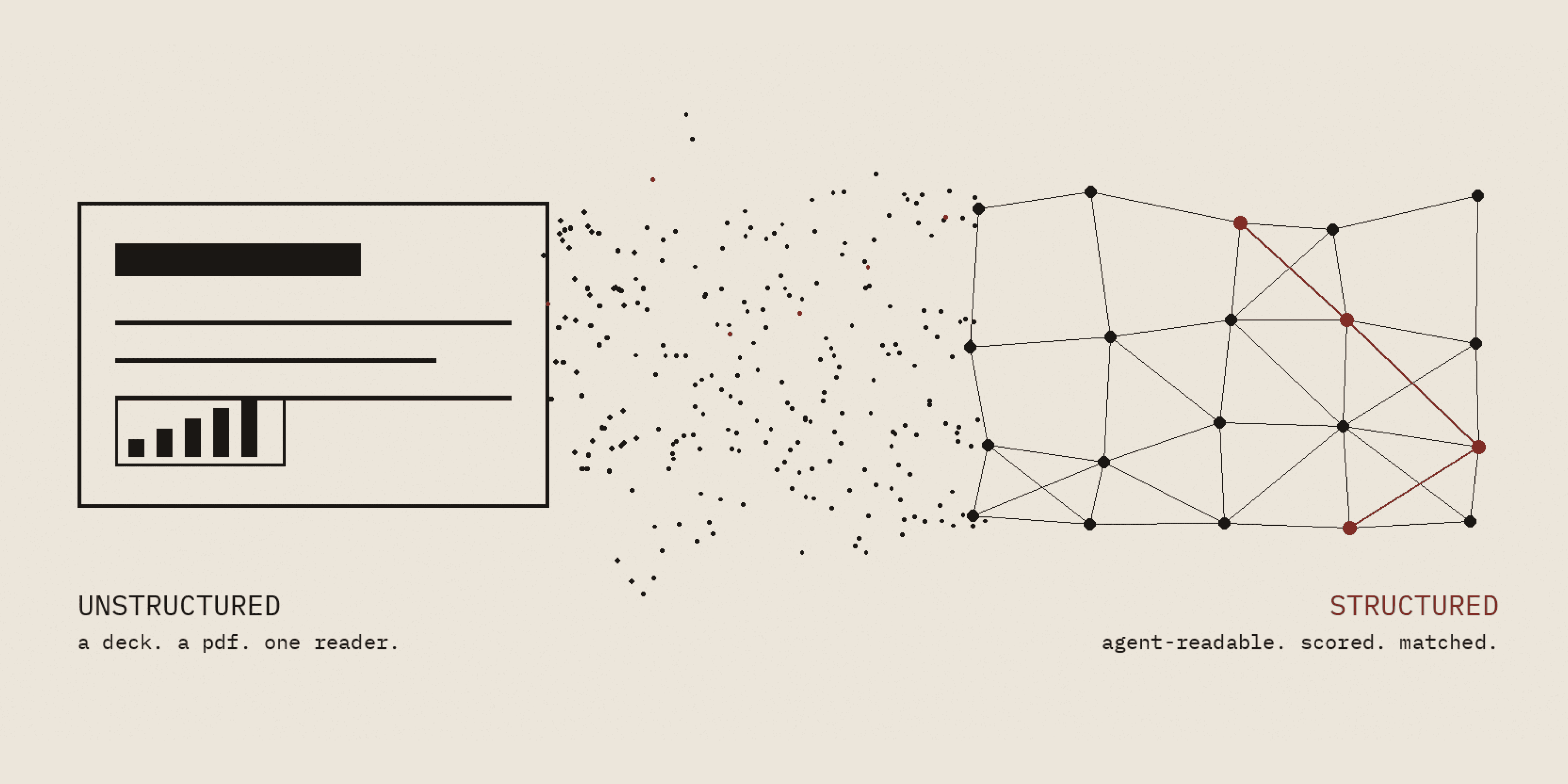
The pitch deck is unstructured data in a world that has moved to structured data. That is the whole story.
A deck is optimized for one human skimming it between meetings. It is built for visual appeal, not for thesis fit. It cannot be queried, scored, or matched against a fund's real criteria without a person retyping it into something useful. Every fund that now runs AI over its inbound is, in effect, paying to convert your beautiful PDF back into the data you should have sent in the first place.
The deck rewarded the wrong things too. Proximity to capital beat quality of company. A warm intro from the right person outweighed a better business with no network. The lottery favored the people who were already close to the prize.
I am not mourning it. I helped kill it. RIP Pitch Deck.
The harder truth is about us, not the deck
Here is where most of my peers will nod along and then do the easy thing.
Every fund in the country is now adopting AI. They are summarizing decks faster, drafting memos faster, doing more with less. That is real, and it is also a patch. You are bolting a faster engine onto a process that was designed for the speed of calendars and inboxes. You get a quicker version of the old asymmetry. The founder still waits. The partner still triages. Nothing structural changed.
The weakest move in venture right now is to treat AI as a productivity upgrade. The founders have already lapped you. They are not operating a faster law firm. They are operating a different kind of company, and they can feel the difference the moment they touch your process.
The next generation of venture will not win by adopting AI. It will win by being AI-native at the operating level. Not the marketing level. The operating level.
Agents in the deal flow, not a human opening every inbound.
MCP as the front door, so a founder's agent can talk to your fund directly.
Decisions measured in days, because the mechanical work runs continuously in the background and the human shows up only for the judgment.
If a founder's company runs on agents and speed, and your firm runs on inbox triage and a calendar, you are not a partner to them. You are friction they will route around.
Why we built Pitch Protocol at the Studio
This is the reason we built Pitch Protocol inside Growth Factory Studio.
It is a machine-to-machine fundraising protocol.
A founder's agent submits through MCP, an API, or the web.
The application runs through a multi-agent pipeline that produces a research report richer than most associates could assemble in a week.
The fund receives structured, scored, signal-rich deal flow matched against its thesis and its stage.
Every application gets the same rigorous front door, whether the founder is in Palo Alto or somewhere no partner has ever flown to.
Humans still decide. Agents handle the protocol. Capital allocation stays with people, because trust in venture is built between people and we will not erode that.
We did not build it alone, and it was never meant to be ours to keep. A founding group of funds signed on early, before there was much to see beyond the conviction. They did not join to save time on inbound. They joined because they read the same shift we did and decided to help build the front door rather than wait for someone else to define it. A protocol only matters if more than one party trusts it, and the funds backing this one are betting on the same future the best founders are already living in.
We did not build it to do venture faster. We built it so Growth Factory Ventures can show up at the speed the best founders already operate at, and earn the right to invest in them. An AI-native founder can tell within one interaction whether you live in their world or theirs. We would rather meet them where they are than ask them to slow down to where we used to be.
The pitch deck is dead. The funds that understand why are the ones building what comes next, not the ones speeding up what is already gone.
We would rather build it than watch.
Ali Mackani
Reach Out
We’d love to hear from you.

Stay connected with insights, opportunities, and updates from our ecosystem.